Dateline August 13, 2013, The Franklin D. Roosevelt Presidential Library and Museum
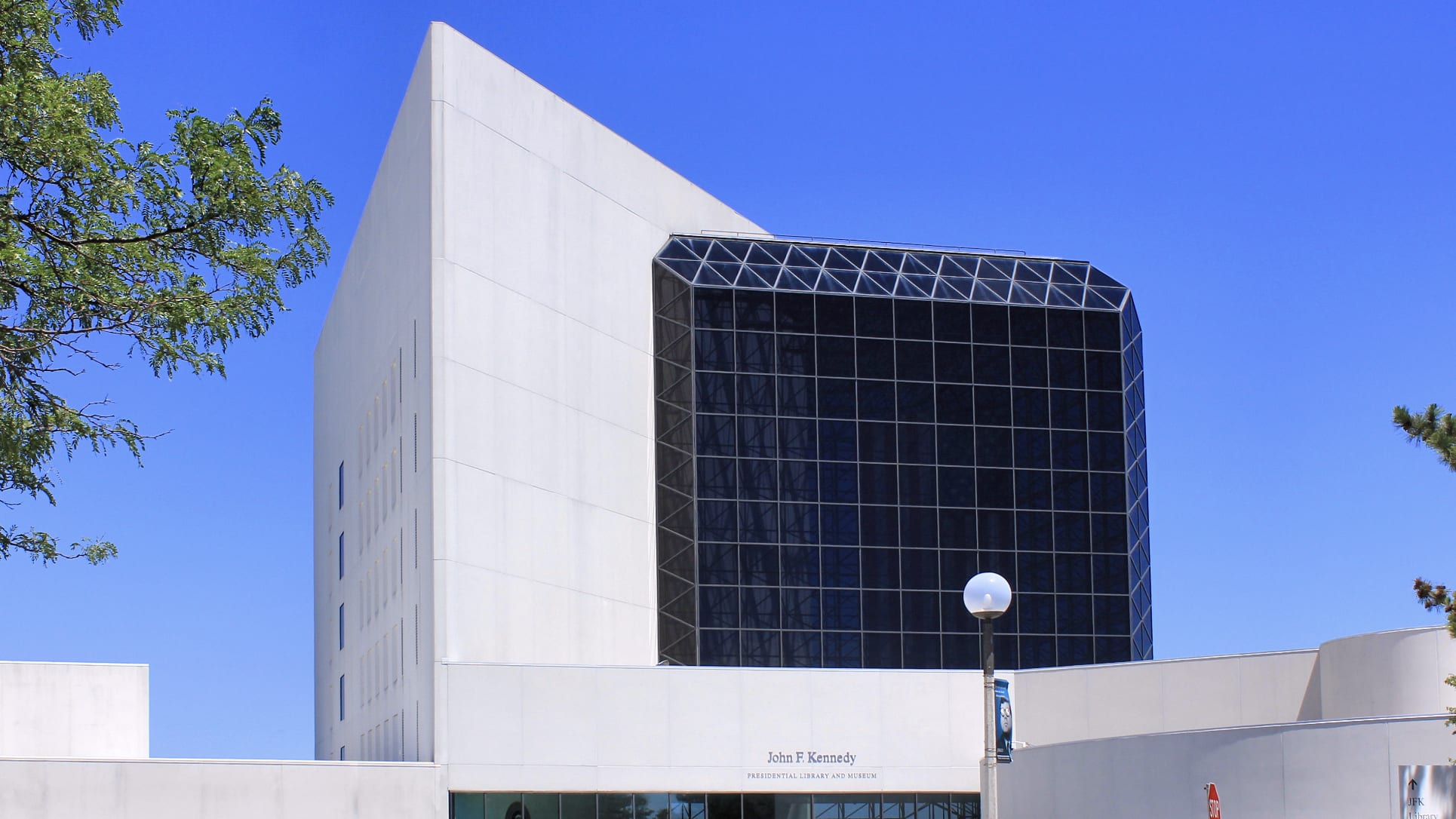
After the John F. Kennedy Library in Boston, we drove west across Massachusetts and into New York, on our way to Hyde Park and the Franklin D. Roosevelt Presidential Library and Museum. This was our sixth and last presidential library of the year. It also happens to be the one that created the model for all the others.
We arrived in the morning and went to the Welcome Center. The library sits on the old Roosevelt estate, developed in part by FDR's father. The grounds are beautiful, sweeping down toward the Hudson River.
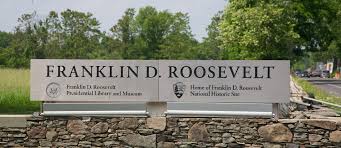
FDR dedicated the library himself in 1941, which made it the first presidential library in the United States. He set out what has become the standard model: a privately financed library, built on a sweeping family estate, then donated to the federal government and managed by the National Archives. Every president since who has chosen to build a library has followed the same template.
The library had just completed a $35 million renovation. According to our guide, the new permanent exhibition represented the first major rethinking of how FDR's life and presidency are presented in over seventy years, the first major overhaul since FDR dedicated the place himself. The 12,000-square-foot exhibition hall is amazing, with interactive video tables and digital "flip-book" screens.
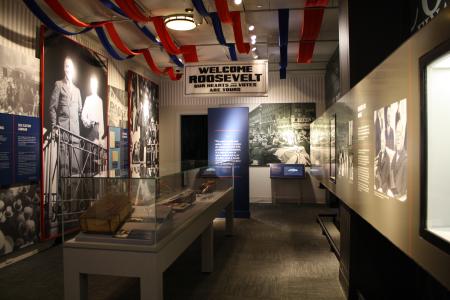
The theme of his 1932 campaign was "Happy Days Are Here Again," and the song still greets you as you walk in. The exhibition takes Roosevelt from his inauguration in March 1933 at the bottom of the Great Depression, through April 1945, when he died suddenly at the cusp of victory in World War Two. The world was thoroughly transformed during his time in office.
The early years.
Franklin Delano Roosevelt was born here at Hyde Park on January 30, 1882. He was a fifth cousin to Theodore Roosevelt, who would become president when Franklin was nineteen. He went to Harvard and then to Columbia Law School, and entered Democratic Party politics in New York. President Woodrow Wilson appointed him Assistant Secretary of the Navy in 1913, the same position Theodore Roosevelt had held a generation before. Franklin served through World War One. In 1920 the Democrats nominated him for Vice President on the ticket with James M. Cox. They lost.
Polio at Campobello.
In August 1921, on summer holiday with his family at the Roosevelt cottage on Campobello Island, in New Brunswick, Canada, the thirty-nine-year-old Roosevelt fell ill. Within days he was paralyzed from the waist down. The diagnosis was poliomyelitis. He would never walk unaided again.
We had visited the Campobello cottage the year before, on our way through Maine and New Brunswick. Standing at the FDR Library at Hyde Park and remembering the small bedroom on Campobello where the illness took hold was an unexpectedly moving piece of continuity. The career that would shape the next forty years of American history almost ended in that room, eight hundred miles north of here.
Instead of leaving public life, Roosevelt rebuilt himself. He spent years at Warm Springs, Georgia rehabilitating in the heated mineral waters, and eventually returned to politics. He was elected Governor of New York in 1928, re-elected in 1930, and from there ran for the presidency in 1932. He beat Herbert Hoover by a wide margin, carrying forty-two of the forty-eight states.
The inauguration.
Roosevelt was sworn in on March 4, 1933, at the bottom of the Great Depression. More than eleven thousand of the country's twenty-four thousand banks had failed. Unemployment was at twenty-five percent. He gave a speech that contained the line everyone remembers:
"The only thing we have to fear is fear itself."
The full inaugural address is on YouTube (here). It is worth a listen.
The first hundred days.
What followed was one of the most consequential bursts of legislative activity in American history. The Civilian Conservation Corps put young men to work on public lands. The Public Works Administration built dams, bridges, schools, and post offices. The Federal Deposit Insurance Corporation made bank deposits safe. The National Recovery Administration tried to coordinate industrial recovery. The Tennessee Valley Authority brought electricity to a region that had been mostly off the grid.
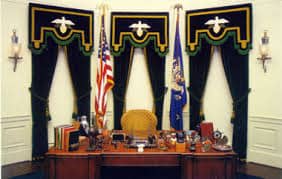
In 1935 came Social Security, the most enduring of all the New Deal programs.
Roosevelt also introduced something new to American politics: the fireside chat. He would sit in front of a radio microphone, often at the White House, and speak directly to the American people about whatever he wanted them to understand. He had a gift for it. The country had never had a president talk to them this way before. They have had several since.
The numbers tell the larger story of the years he was in office. When he took the oath, twenty-five percent of the country lived on farms, and the federal government played a relatively small role in the daily economic life of most Americans. By 1950, only sixteen percent lived on farms. From 1930 to 1945, the share of unionized workers in the workforce went from seven percent to about thirty-five percent. The New Deal Coalition that he built realigned American politics for a generation. His domestic program defined what came to be called American Liberalism for the middle third of the twentieth century. The country he left was a different country from the one he had inherited, and it is the country we still live in today.
The setbacks.
The library does not pretend the record was unblemished. In 1937 Roosevelt proposed to add up to six new justices to the Supreme Court, expanding the bench from nine to as many as fifteen, after the existing court struck down several New Deal programs. The plan was widely seen as an attempt to pack the court with friendly votes, and even his own party turned against it. The proposal failed. That same year, the economy slipped back into recession. Both episodes are presented honestly.
The road to war.
Through the late 1930s, the world darkened. Japan invaded China in 1937. Nazi Germany annexed Austria, dismembered Czechoslovakia, and invaded Poland. Roosevelt gave strong diplomatic and financial support to China and Great Britain while keeping the United States officially neutral. He coined the phrase "Arsenal of Democracy" to describe the role he wanted America to play, supplying munitions and equipment to the Allies. In 1941 Congress passed Lend-Lease, his program to send war material to Britain and the Soviet Union before America was formally in the fight.
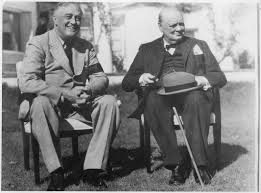
Then, on Sunday, December 7, 1941, the Japanese attacked Pearl Harbor. The next afternoon, in front of a joint session of Congress, Roosevelt asked for a declaration of war:
"Yesterday, December 7, 1941, a date which will live in infamy, the United States of America was suddenly and deliberately attacked by naval and air forces of the Empire of Japan."
The full Day of Infamy speech is on YouTube (here). It runs about six and a half minutes. Congress approved the declaration of war that same day, with one dissenting vote in the House.
The unprecedented terms.
Roosevelt had broken George Washington's two-term tradition in 1940, when he ran for and won a third term. The country was at the edge of war and chose to keep the leader it had. In 1944 he ran again, with Harry Truman replacing Henry Wallace as Vice President. The fourth term would be his last. After Roosevelt's death, the Twenty-Second Amendment to the Constitution limited future presidents to two elected terms.
Yalta and Warm Springs.
In February 1945, with the war in Europe nearly won, Roosevelt traveled to Yalta in the Crimea to meet with Churchill and Stalin and shape what the postwar world would look like. He was visibly exhausted. Two months later, on April 12, 1945, while resting at his retreat at Warm Springs, Georgia, he died of a massive cerebral hemorrhage. He was sixty-three. Harry Truman, who had been Vice President for less than three months, became the thirty-third President of the United States and inherited the war and the atomic bomb that had been developed under Roosevelt's authority. Truman used it to end the war in the Pacific that August.
Eleanor.
A real portion of the library is given to Eleanor Roosevelt, the most consequential First Lady in American history to that point. She used her position to advocate for civil rights, women's rights, and the dignity of working people. After Franklin's death, Truman appointed her as a delegate to the United Nations, where she chaired the Commission on Human Rights that produced the 1948 Universal Declaration of Human Rights. She remained a major figure in American public life until her own death in 1962.
The artifacts.
The displays draw on more than seventeen million pages of documents, an enormous collection. Among the smaller things that catch you: a 1882 baptismal certificate, marking the start of the life. A 1943 sketch in Roosevelt's own hand of what a postwar "United Nations" might look like, drawn two years before the UN's founding charter was signed in San Francisco. And the car he drove around the Hyde Park estate himself, modified with hand controls because his legs would not cooperate.
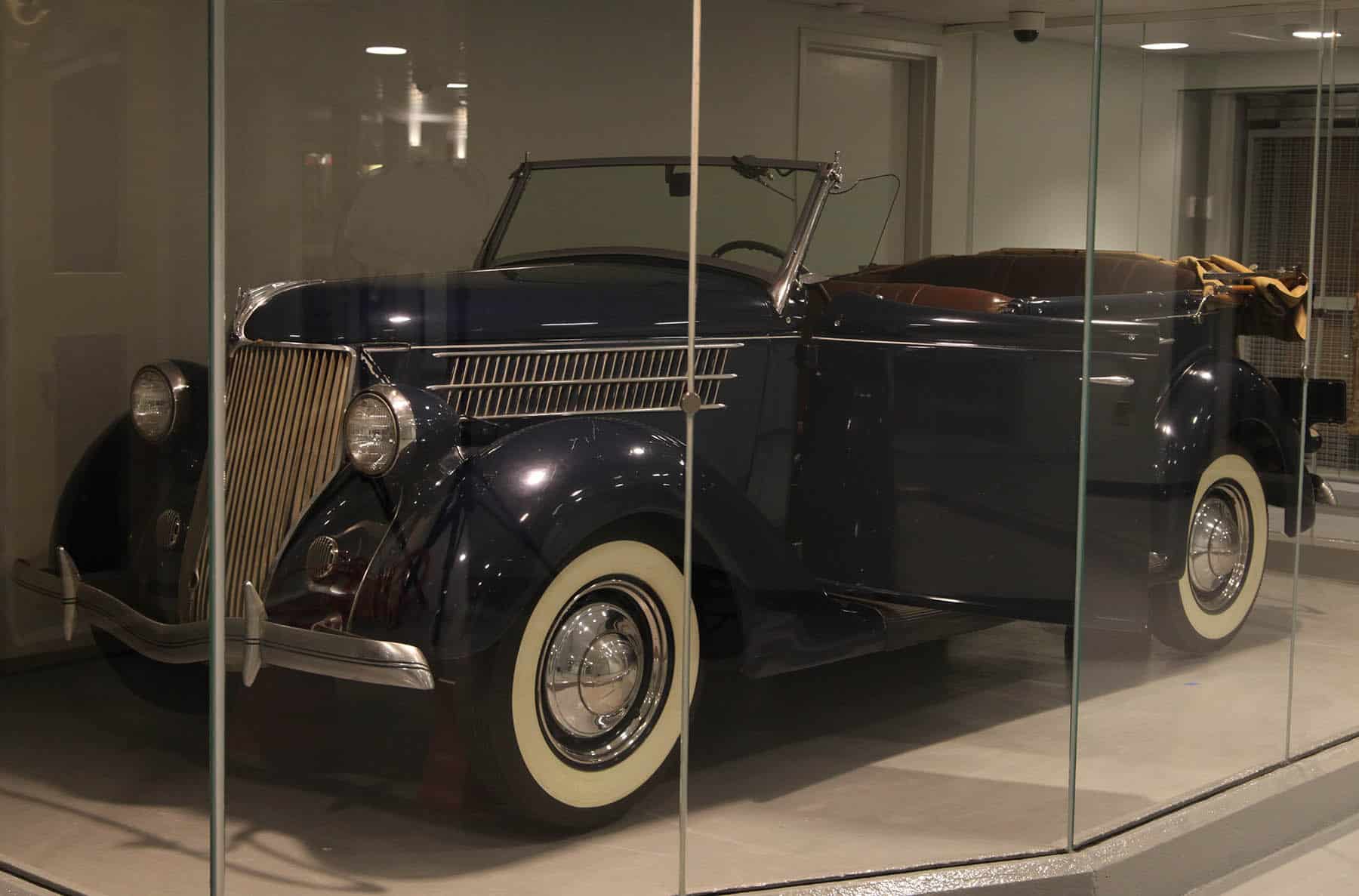
He never let the wheelchair appear in public photographs. The press of his day largely agreed not to show it.
A closing thought.
FDR is considered by most American historians to be one of the top three presidents, alongside Abraham Lincoln and George Washington. Lincoln held the Union together through civil war. Washington founded the office itself. Roosevelt led the country through the Great Depression and the largest war in human history, and the country that emerged from those twelve years was a fundamentally different one from the country that entered them. The exhibits and presentations at the renovated library are extremely well done, and a visit is the best history lesson on this period of American life we can think of.
This was our sixth and last presidential library of the year. Quite an education.