Dateline August 19, 2017, New Brunswick and the Bay of Fundy
We crossed the border into Canada and turned south to pick up the Fundy Coastal Drive, the road that follows the great Bay of Fundy. We began in Saint Andrews, a wonderful little town. On our last trip we had taken the ferry from there over to Campobello Island, where a young Franklin Roosevelt spent his summers at the family home. This time we carried on to Saint George, a small village that happened to be holding a farmers market at the local Royal Canadian Legion hall. It was a modest affair, but we came away with some sausage and a loaf of sourdough, and good conversation with the locals, who were a lot of fun.
The Bay of Fundy. The bay is a genuine wonder. It holds the highest tides anywhere on earth, and in a single tide cycle more water moves in and out of it than flows from all the freshwater rivers in the world combined, something on the order of a hundred billion tons every twelve and a half hours. It sits in a long rift valley between New Brunswick and Nova Scotia, shaped like a great funnel that narrows and grows shallower toward its head, which is what drives those enormous tides. Even the name is a small mystery: some say "Fundy" comes from the French fendu, meaning split, and others from the Portuguese fondo, for funnel. Either way, it is a place to marvel at.
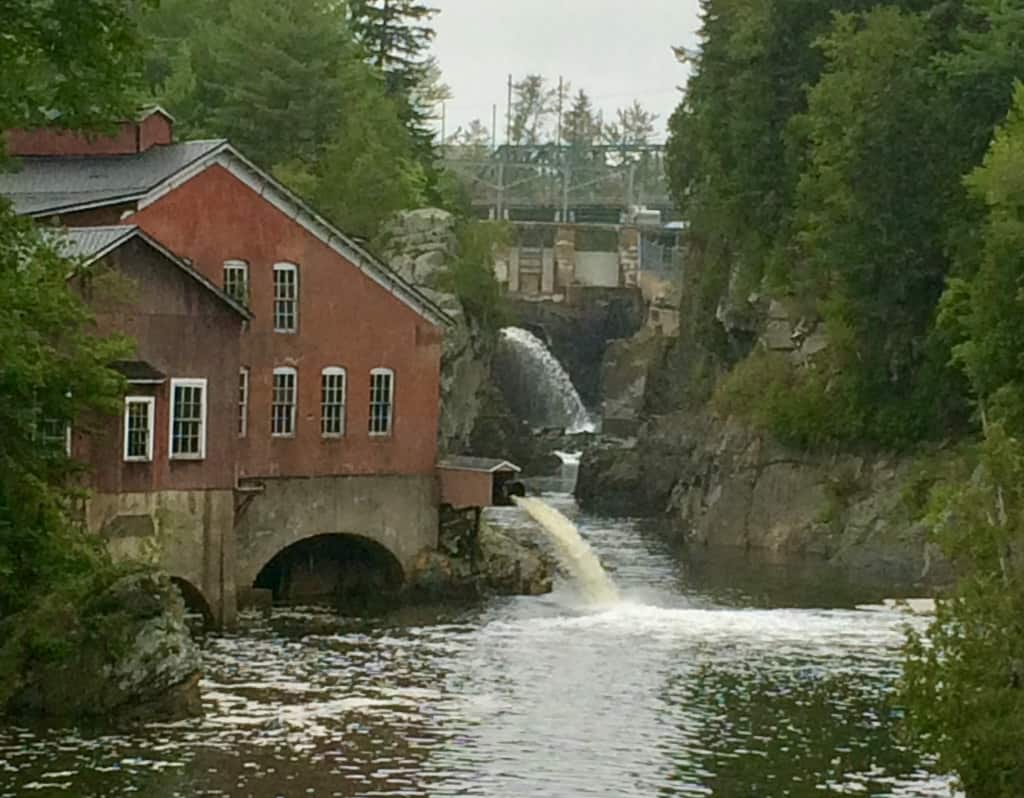
We made our way back up to Saint John and spent the night at the Rockwood city park. It rained most of the time, so any thought of golf was out. In the morning we started back along the bay with Amherst, Nova Scotia, as our destination. Driving down through the village of St Martin, we crossed an old bridge with a fine view of a waterfall and a barn.
From there the highway left the coast and climbed up to Sussex, then dropped back down to Fundy National Park, a popular spot for camping and hiking. At the far end of the park is Alma, a postcard of a town that we remembered fondly from our last trip through. Then it was on into Nova Scotia, where some golf was waiting.